
Ventilation design in industrial halls differs significantly from standard solutions for office and commercial buildings. Large airflows, variable loads, process heat, and industrial contaminants impose higher requirements on both sizing and equipment selection
In 2026, particular emphasis will be placed on energy efficiency, modern heat recovery (HR) solutions, and maintainability of units.
1. Input Data – Where Sizing Always Begins
Correct sizing in industrial halls requires more detailed input data than usual:
✔ Volume and Usage
- production, storage, welding, packaging, surface treatment, process kitchens
- air demand can vary significantly between different spaces and zones
✔ Occupancy and Equipment Load
- production equipment heat output 5–40 W/m³
- number of personnel and work areas
✔ Contaminant Load
- dust, welding fumes, grinding dust, humidity, chemical vapors
- affects filter classes and HR solution
✔ External Conditions
- freezing temperatures
- humidity peaks
- door usage (rolling doors, loading traffic)
✔ Energy Requirements and Target HR Efficiency
- typical target 70–85 %
- every percentage point is financially significant in large airflows
2. Airflow Sizing – The Most Important Cost Factor
Airflows in industrial halls can be calculated from three perspectives:
1) Occupancy-based sizing
- 20–30 l/s per henkilö → riittää kevyeen teollisuuteen.
2) Space-based sizing / Air Changes
Typical air changes:
- warehouse 1–2 1/h
- production area 3–6 1/h
- heavier process 8–15 1/h
3) Contaminant and Heat Load-based Sizing
Usually decisive in industrial applications.
Example:
- equipment load 20 W/m³ → airflow 4–6 m³/h/m²
Recommendation: Always select airflow based on the highest load factor and add ±20 % adjustment margin for process variations.
3. Filtration – The Cornerstone of Industrial Ventilation
In industrial halls, filtration determines:
- energy efficiency
- pressure differentials
- HR operation
- unit lifetime
Recommendation
- Pre-filter: Coarse 65–80 %
- Main filter: ePM1 50–70 %
- Special applications: HEPA, activated carbon, or chemical filters
A large filter surface area is critical. Bag filters or compact cassette filters are suitable for large airflows – but the correct surface area must be ensured to keep pressure drop under control.
4. Selecting the HR Solution – Energy Savings 20–40 %
Rotary Heat Exchanger (80–90 %)
- best efficiency
- suitable for large airflows
- not recommended for very dirty processes without a separate solution
Plate Heat Exchanger (60–75 %)
- cost-effective and reliable
- easy to maintain
- better suited to industrial contaminants
Liquid-Circulated HR
- when supply and exhaust air must not mix
- suitable for high-temperature or odorous exhaust streams
5. Fans, Pressure Losses, and SFP Values
Typical challenges in industrial halls:
- long duct runs
- high pressure drop across filter packs
- cold conditions → risk of freezing
Recommendation:
- EC fans as standard
- SFP target 1.0–1.5 kW/(m³/s)
- Overdimension fans REASONABLY: 10–20 % adjustment margin, no more
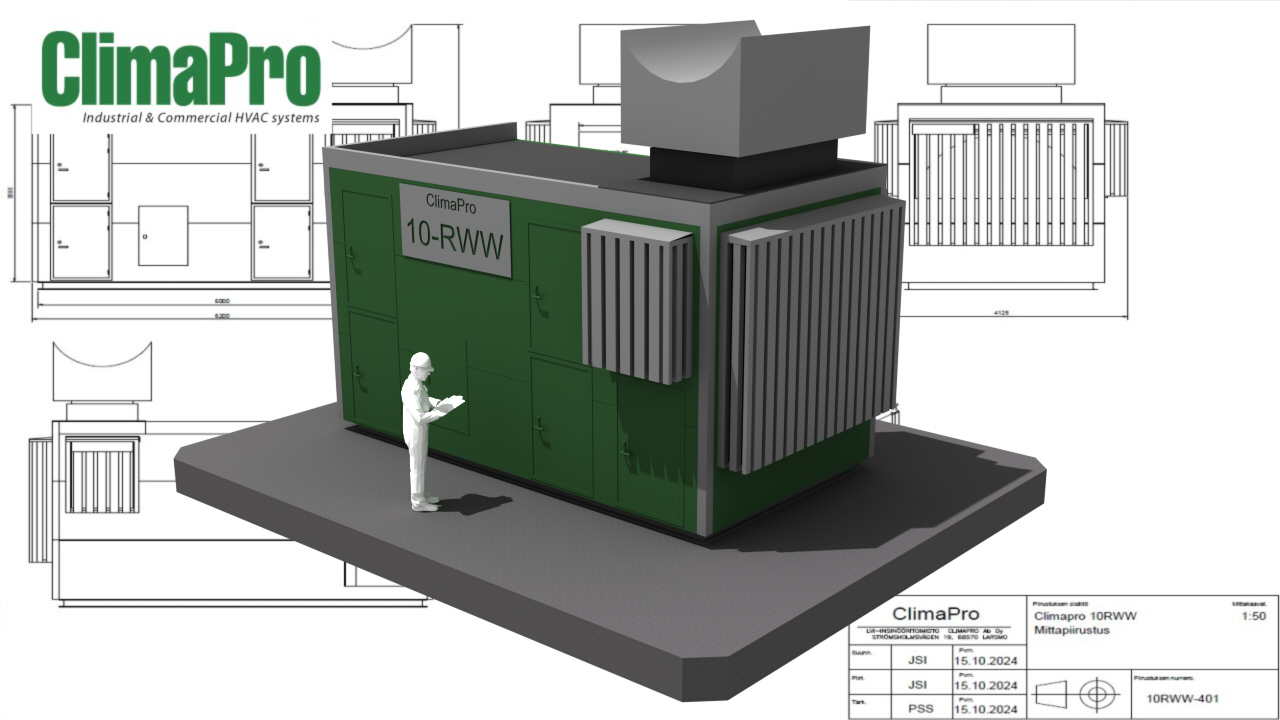
6. Externally Mounted HVAC Units – Best Solution for Space-Limited Halls
Increasingly, industrial halls are moving to externally mounted HVAC units because:
- interior space is freed for other uses
- larger HR surface area → better efficiency
- easy to install and maintain
- can be sized without machine room limitations
This solution is particularly practical for renovations and halls with airflows exceeding 5 m³/s.
7. Summary
✔ Calculate airflows based on load
✔ Prefer high-efficiency HR solutions
✔ Ensure sufficient filter surface area
✔ Use EC fans and reasonable adjustment margin
✔ Use externally mounted units when space is limited
✔ Design the unit for easy maintenance
A properly sized HVAC unit can save in an industrial hall:
- 20–40 % energy per year
- significant operating and maintenance costs
- improve indoor air quality and safety