
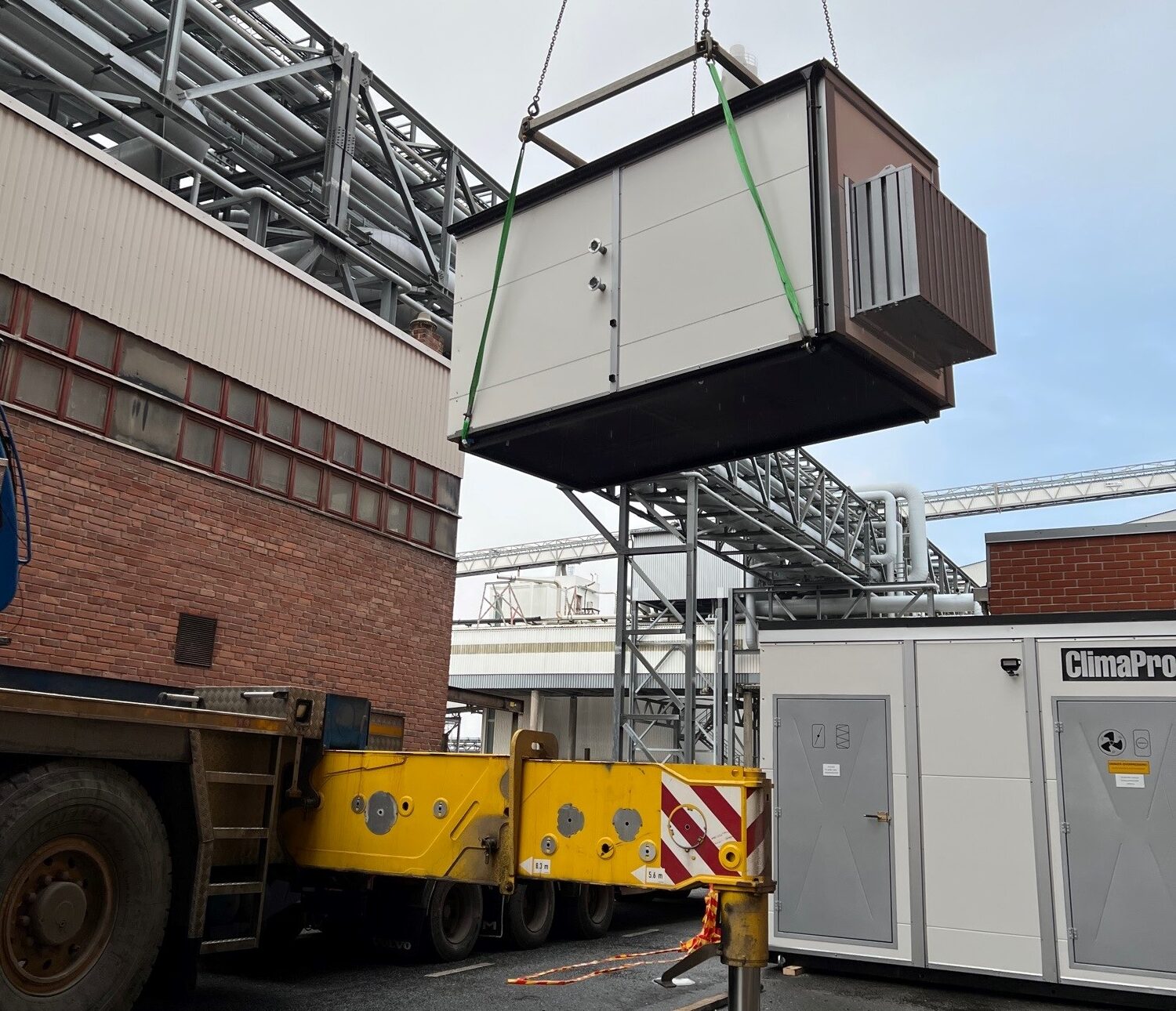
Ventilation in industrial buildings is a demanding challenge – volumes are large, the amount of contaminants varies, and environmental requirements can be strict. Nevertheless, many of the same problems occur from one building to another. Below are the most common challenges and practical solutions that can help improve energy efficiency, safety, and production process quality.
1. Insufficient Airflow
Problem:
In many industrial buildings, the ventilation system is undersized or was designed for the original use of the facility rather than the current production load. This can result in high temperatures, slow removal of contaminants, and an uncomfortable working environment.
Solutions:
- Update the ventilation design based on the actual process loads (heat, dust, gases).
- Install additional exhaust systems where necessary (local exhaust ventilation, waste-heat exhaust stacks, process exhausts).
- Use properly sized industrial or customized air handling units (AHUs), rather than solutions designed for office buildings.
2. Heat Recovery Deficiencies or Low Efficiency
Problem:
With large airflows, huge amounts of thermal energy can be wasted, especially when the heat recovery system is outdated or poorly optimized.
Solutions:
- Upgrade the heat recovery system to a counterflow plate heat exchanger or a run-around coil system, with a target efficiency of 60–80%.
- Take contaminants into account: applications prone to fouling require a design that is easy to clean.
- Optimize control based on outdoor temperature.
3. Overpressure and Negative Pressure Problems
Problem:
Pressure differences in industrial buildings can cause difficulties opening doors, heat losses, drafts, or the spread of harmful contaminants into areas where they should not be present.
Solutions:
- Balance supply and extract airflows.
- Use intelligent pressure control systems in critical areas.
- Check that secondary airflows, local exhaust systems, or process units are not disrupting the pressure balance of the building.
4. Fouling and Poor Filtration
Problem:
Industrial environments can quickly clog filters. Airflow decreases, energy consumption increases, and the service life of the equipment is shortened.
Solutions:
- Use an adequate filtration class (e.g. F7–ePM1).
- Choose an easily serviceable filter design, such as cassette filters or Varicel-type solutions.
- Monitor filter pressure differentials automatically rather than relying on guesswork.
5. Incorrect Airflow Distribution
Problem:
If air is not distributed evenly, one part of the building may be hot and stagnant while another is drafty. Employees notice these differences immediately.
Solutions:
- Design the correct air discharge direction and throw distance for the building.
- Use displacement ventilation systems designed for high spaces and balanced supply air devices.
- Utilize computational fluid dynamics (CFD) modelling in large or critical applications.
6. Inadequate Maintenance
Problem:
Ventilation systems in industrial buildings are exposed to demanding conditions, and without regular maintenance, their efficiency can deteriorate significantly.
Solutions:
- Carry out annual maintenance: filters, heat exchangers, belts, fans, sensors, and frost protection.
- Automate fault notifications (fan failure, risk of freezing, filter alarm).
- Check airflow rates at least every two years.
7. Uncontrolled Energy Consumption
Problem:
The energy consumption of large air handling units can increase significantly if the control system is not up to date.
Solutions:
- Switch to variable frequency drive (VFD) control if this is not already in use.
- Use demand-controlled ventilation (temperature, CO₂, VOC, or pressure control).
- Optimize the operation and operating hours of process exhaust systems.
Summary
Ventilation in an industrial building performs well when:
- airflow rates are correctly designed
- heat recovery is efficient
- pressure differences are under control
- filtration works effectively and maintenance is carried out regularly
- sufficient attention is paid to air distribution
A well-designed and properly maintained ventilation system saves energy, improves safety, and significantly enhances working conditions.